 Việt Long Trà
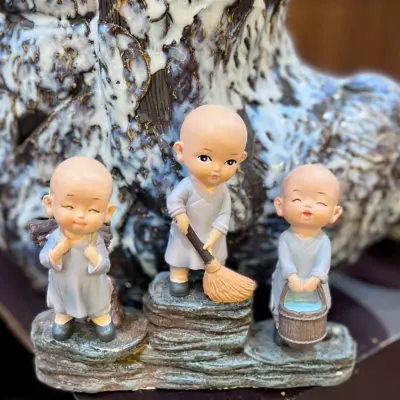
SET OF 3 LITTLE MONKS DOING CHORES
270,000 ₫
· 6 min read · Việt Long Trà
On a tea tray everything has a job: the pot brews, the cups hold, the pitcher divides. Only one thing does nothing at all — and it is the one thing that changes because you drink tea.
In Chinese the small figures kept on the tray are called chá chǒng (茶宠), literally tea pets. Vietnamese calls them pet bàn trà, tea-table pets. The practice is the same everywhere: when the brewing is done, pour what is left in the pitcher over the figure, and do it again tomorrow.
For the same reason people season a zisha pot. Unglazed clay is never sealed, so the surface takes tea in, dries, and keeps a very thin trace of it. Repeat that a few hundred times and the figure darkens and gains a sheen — the sheen of skin, not the sheen of glaze.
Plainly: only bare clay can be fed. Moulded plastic and glazed ceramic are tea pets too, still handsome and still good as a gift — but no amount of tea will season them. On our shelf the moulded novice-monk sets are the cheap end, while a handmade zisha figure spans a wide range and runs into the millions. That gap is not a gap in size.
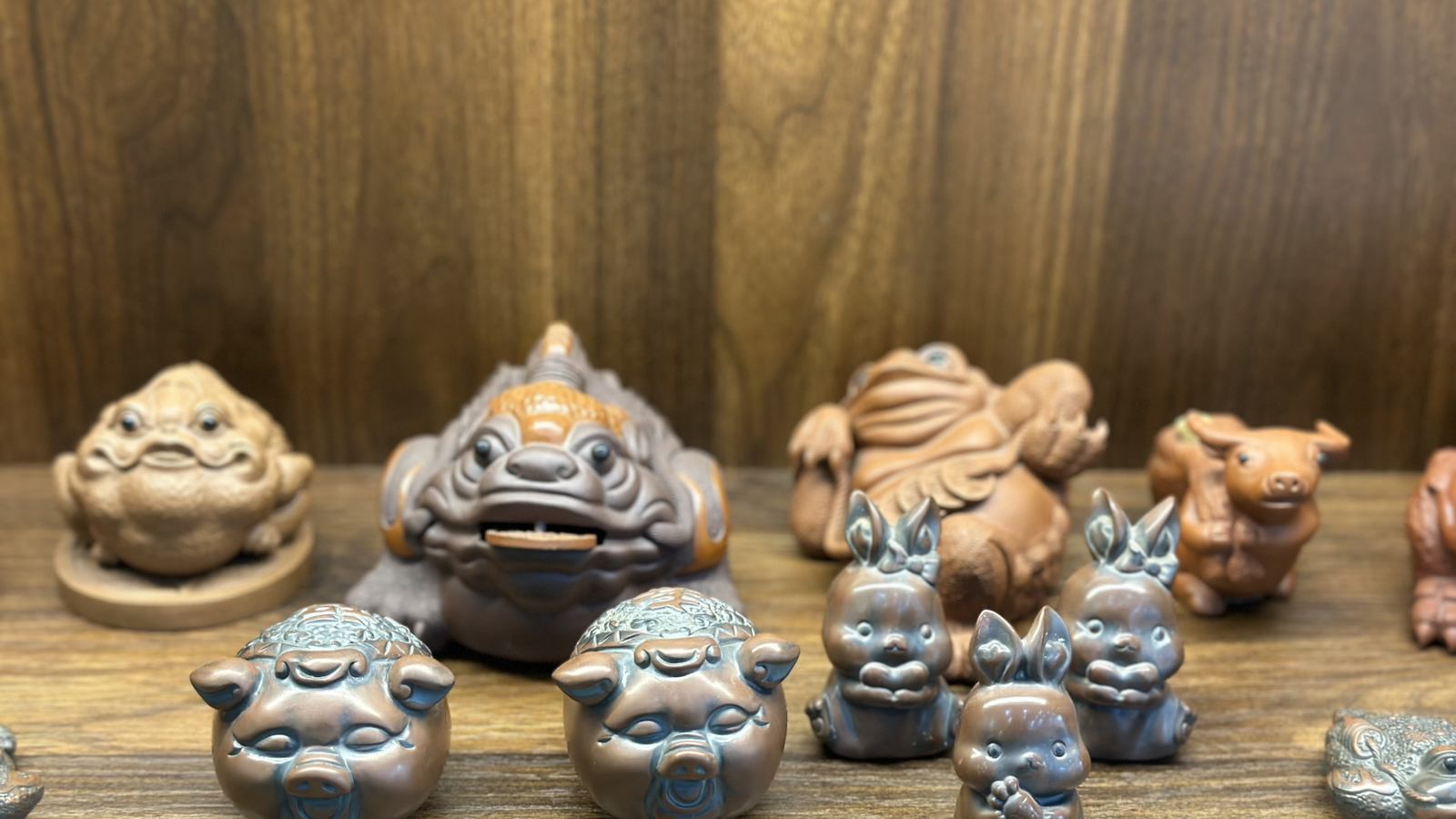
Thiềm thừ (蟾蜍) is the figure you meet most often on a Vietnamese tea table, and the easiest to recognise: a toad, but with only three legs. The story has Liu Hai fishing a three-legged toad out of a well and the toad spitting out coins, which is how it became a symbol of drawing in wealth. The gold-ingot jar belongs to the same family — a small pot heaped with ingots, a fist across, set beside the teapot.
There is one placement convention worth remembering: with a coin in its mouth it faces into the house, without one it faces the door. The one holding a coin is bringing money home, so point it inward; the one with an empty mouth is out looking, so point it out.
On the shelf the toads form a clear ladder — by clay, not by size. Cheapest is zisha ceramic, small then medium; above that handmade Zi Ni; at the top Da Hong Bao. The same toad throughout; what differs is the clay and the hand that shaped it.
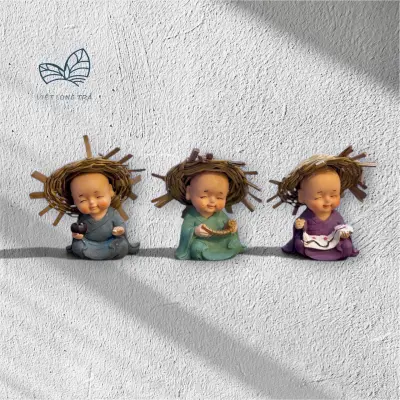
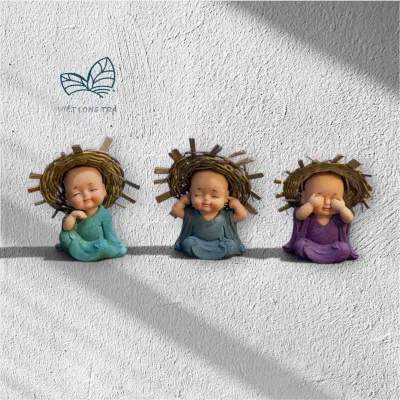
The three-noes set is three young monks covering eyes, ears and mouth: see not, hear not, speak not. People reach for the three monkeys at Nikkō in Japan; further back still, the Analects carries a line very close to this — what is contrary to propriety, do not look at, do not listen to, do not speak of, do not do. Four clauses, and the set keeps three. On a tea table the set admonishes nobody — it only points out that once you sit down to brew, there is less to say.
The at-ease set is the opposite: monks leaning back, lying down, chin propped on a hand, each idle in his own way. Tự tại means unhurried, unencumbered. This set suits the table you brew at alone better than the one you receive guests at.
The little gourd, pumpkin and melon figures have a trick of their own: pour boiling water over them and they send up a jet of water. There is no mechanism inside. The figure is hollow with a pinhole; stand it in cool water and it draws water in — not to the brim, there is still a pocket of air in its belly. Pour hot water over the outside and that pocket expands, driving the water back out through the hole.
Because it only spouts when the water is hot enough, brewers use it as a rough thermometer: if it will not spout, the water is not yet fierce enough for teas that want a hard boil.
A few months and you notice; a few years and it is obvious. That is the only reward here, and it is not for sale.
Pick one you like the look of, keep it on the tray, and pour tea over it every time you brew. In a few years it will be the oldest thing on the table.